Review (Rapunzel)

Bibliography: Zelinsky, Paul O. Rapunzel. New York, New York: Dutton Books for Young Readers (Penguin Books USA), 1997. ISBN-13: 978-0525456070

Plot Summary: A couple are expecting a baby. The wife sees a sorceress’ garden and falls in love with the rapunzel growing there. She is suddenly overcome with the desire to eat it, a desire so desperate that she swears she will die if she cannot have it. Therefore, the concerned husband sneaks into the garden and steals the rapunzel. The wife is happy, but wants more. When he goes into the garden for the second time, he is caught by the sorceress. The sorceress raises her arms at him, her dark green cloak billowing about her menacingly as she tells him, “How dare you come here to steal my rapunzel! Oh, it will serve you ill!” The husband begs for mercy and the sorceress strikes a deal. He can take as much rapunzel as he needs to, but he will have to give his first-born child to her. Because he worries about his wife’s health, he agrees. The wife lives and gives birth, “And when the child was born, the sorceress appeared in the room. She named the baby girl Rapunzel and carried her away.” The sorceress raises the girl with dedication but also domination. Once Rapunzel grows up, the sorceress locks her in a tower out in the woods. There is no door to the tower, but the sorceress can come and go as she pleases because Rapunzel “would unpin her…braids, wind them around a hook on the window frame, and let them tumble all the way to the ground. The sorceress would grab hold of them and hoist herself up.” Rapunzel lives an isolated life, never seeing anyone outside the sorceress. One day, she sings to the birds and a prince hears it while he is riding through the woods. He becomes interested to just who that voice belongs to. He is able to sneak into the tower, and he and Rapunzel meet and fall in love. He visits frequently and they even marry within the tower. Eventually, Rapunzel gets pregnant and the sorceress disowns her when she discovers this. She gets thrown out into the woods where she eventually gives birth to twins. The prince tries to return to the tower, but the sorceress scares him into falling down. He loses his eyesight in this ordeal. He travels through the woods, lost and bereft. Rapunzel discovers him. Her tears cure his blindness and they are able to live happily ever after with their twins in the prince’s home.

Critical Analysis: A theme of the book is that there are different types of love, some good, some not. The sorceress and Rapunzel’s parents do not have a healthy love toward Rapunzel. The sorceress and the parents contrast one another, with the former being clinging and dominating and the latter weak-willed enough to give their own flesh-and-blood away. Zelinsky does a powerful depiction of the sorceress taking away Rapunzel from her parents. While he describes the event in one page, he illustrates the whole thing onto two other pages, depicting it without any words, amplifying the seriousness of what has happened. The parents’ faces are interesting as they look on the sorceress walking away with the baby. The mother looks exhausted and unsure, while the father is touching his throat, looking lost and distressed.

The reader can see that the parents regret what they have done, but it is too late. If the parents’ love for Rapunzel was weak, the sorceress’ love dominating, then the healthiest love would have to be from the Prince. While parents may be concerned that the Prince tricks Rapunzel into letting him up, the relationship otherwise proves to be a mutual love once he “began to speak to [Rapunzel] in such a friendly way that her fear was soon gone.” They are dedicated to one another, even marrying within the tower.

The illustrations are exquisite, oil paintings done to the style of Italian Renaissance, where Rapunzel has glimmering gold-red hair, and most of the tones are warm and earthy. Zelinsky actually states in an afterword that he found Italy fitting as it was one of the original countries of the tale. Not to mention, it went well with the symbols of the story. Zelinsky states “…the very image of a tower evokes the Italian landscape, where the campanile, or bell tower, plays a prominent role in architectural tradition. (The closeness of the word to Campanula, the name of the bellflower genus to which rapunzel belongs, helped me believe I was setting out on the right track.)”

A motif that occurs is how Rapunzel, named after a plant, is passed onto different people like she herself is no more than a plant, a thing take ownership on. She is given off to the sorceress by her own blood, the sorceress passes her off to the woods, and, though, she and the Prince’s relationship is the healthiest, he does in some ways has power over while she is stuck in the tower. He can come and go as he likes, she cannot. It is only until both are thrown out to the world that the relationship is more at level. Both have been harmed and have been surviving on their own when they meet up again. Rapunzel is even given the power to cure the prince of his blindness, therefore having him rely on her as much as she him.

A theme that ultimately pervades until the end is isolation. The sorceress isolates Rapunzel from the world. She further isolates her by disowning the girl and tossing her out to woods to fend for herself. The prince is eventually isolated himself once he becomes blind and lost for a year in the wilderness. Even the compositions of illustrations take to this theme, highlighting the vastness of the world. The rooms are all large, showing the human forms small in comparison. Even the narrow tower is larger on the inside because of enchantments by the sorceress. Ultimately, the prince and Rapunzel overcome this isolation by relying on one another. It is a great lesson for children, that tragedy and pain can happen, but they are not eternal. People can overcome pain and lead happy lives. It is no wonder this fairy tale still resonates to this day.

Review Excerpt and Awards won:

Awards and honors: 1998 Caldecott Winner; 1998 Carl Sandburg Award Winner.

Following excerpt is from Kirkus Reviews, posted online on June 24, 20101 and originally written October 1, 1997:

“[Zelinsky] draws on many of [versions of the story] to create a formal, spare text that is more about the undercurrents between characters than crime and punishment. Feeling ‘her dress growing tight around her waist’ a woman conceives the desire for an herb from the neighboring garden—rendered in fine detail with low clipped hedges, elaborate statuary and even a wandering pangolin—that causes her to lose her child to a witch. Ensconced for years in a tower, young Rapunzel meets the prince, ‘marries’ him immediately, is cast into the wilderness when her own dress begins to tighten, gives birth to twins, and cures her husband’s blindness with her tears at their long-awaited reunion. Suffused with golden light, Zelinsky’s landscapes and indoor scenes are grandly evocative, composed and executed with superb technical and emotional command.”

He draws on many of these to create a formal, spare text that is more about the undercurrents between characters than crime and punishment. Feeling “her dress growing tight around her waist” a woman conceives the desire for an herb from the neighboring garden—rendered in fine detail with low clipped hedges, elaborate statuary and even a wandering pangolin—that causes her to lose her child to a witch. Ensconced for years in a tower, young Rapunzel meets the prince, “marries” him immediately, is cast into the wilderness when her own dress begins to tighten, gives birth to twins, and cures her husband’s blindness with her tears at their long-awaited reunion.Suffused with golden light, Zelinsky’s landscapes and indoor scenes are grandly evocative, composed and executed with superb technical and emotional command.

Connections: This book is a great way to facilitate discussions on how people should love and respect one another, including asking if it was right for the parents to give Rapunzel, if it was right for the prince to enter the tower without asking Rapunzel, and why was it wrong for the sorceress to hide Rapunzel in a tower. Instructors can also teach students to write on what are the main ideas of certain scenes and how it affects the story. Rapunzel can be a teaching tool on how to summarize stories. This book can also help demonstrate to children how to see that characters can carry both positive and negative characteristics and write them down. For example, it can be considered a good trait of Rapunzel’s father to want to help his wife with her health. It can be considered a bad trait that he does not stand up to to sorceress or even taking her food without her permission.
Review (Turtle Knows Your Name)

Bibliography: Bryan, Ashley. Turtle Knows Your Name. New York, New York: Atheneum Books for Young Readers, 1989. ISBN-13: 978-0689315787.

Plot Summary: In an island village, a little boy is raised by his grandmother, who teaches him how to say his name. He learns to say that he is named Upsilimana Tumpalerado. The grandmother celebrates by dancing with him by the sea where a turtle learns it as well as the boy sings, “Upsilimana Tumpalerado/That’s my name/I took my time to learn it/ Won’t you do the same?” Unfortunately, the little boy’s friends will not remember his name. They call him Long Name without asking. His grandmother always reminds him to teach his name to others, stating, “… Remember, your name is long, but it’s not the longest.” The boy eventually meets the turtle who sings, “Upsilimana Tumpalerado/ I’m so glad you came/ Upsilimana Tumpalerado/ Turtle knows your name.” The boy asks how the turtle learned it, but the turtle swims away. When the boy returns home for dinner, his grandmother challenges him to tell her what her real name is if he wants dessert. She will not take “Granny” as an adequate answer. She tells him, “There are grannies all over the village. Every granny has a name…” The boy sets out for the rest of the story to find out what is her real name is. He looks to see who can help him. It is Turtle who reveals to him that Granny’s real name is Mapaseedo Jackalindy Eye Pie Tackarindy. He gets his dessert. Granny finds out who it is that revealed her name. At the end, Granny and the boy agree to give each other nicknames, affirm that they love their long names and each other.

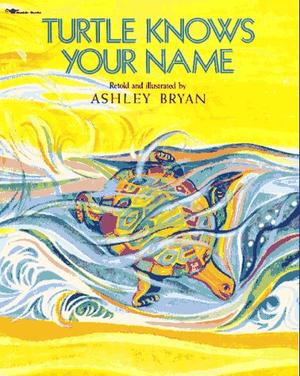
Critical Analysis: This books carries a situation that many children go through, especially immigrants and children of color, where people will not want to practice saying their name if it is not one they are used to. They will even give them nicknames without their permission. His grandmother also reminds him when he goes out to “…teach your name to your playmates and do your best. Remember, your name is long, but it’s not the longest.” The boy gets frustrated that his playmates will not remember what he is called, so he decides to one day spend time with the animals. This is definitely a book to read to children, while singing certain lines and dancing to certain parts. The book is rife with rhythm and rhymes and even some onomatopoeia, such as when the boy travels and whistles “twee-twaa-twee.” When his grandmother serves dinner, they sing “Fungi rolled in a bowl/Till it’s round as a ball/ And as yellow as gold/ Is the best of all.” Ashley Bryan lovingly depicts the Caribbean world his story takes place in by depicting it all in pastels and bold lines, with different skin tones for all its villagers, giving almost a rainbow effect. Ultimately, this is a happy book with happy illustrations.

Review Excerpt and Awards won:

No awards are applied to this book, but the author has received many awards in his career, including the Laura Ingalls Wilder Medal (2009) and the Virginia Hamilton Award (2012), which are two American Library Association career literary awards.

Following excerpt is from Kirkus Reviews, posted online on October 26, 2011 and originally written September 15, 1989: “Full of dancing rhythms and mild humor, the story’s message about the value of the inner lives of those we take for granted is quietly understated. Bryan’s lovely paintings, in light, bright island colors, swirl with joyous patterns; Granny and her boy are full of love and life. Fine for reading, telling, and sharing…”

Connections: This book will be a great way to teach children the importance of respecting other people’s names, especially by asking for permission if they want to be called by a nickname like Upsulimana Tumpalerado and his grandmother do at the end. It teaches them that names are a way for people to say who they are. Have the children write out their own names in big, block text and have them draw art within the letters that best represent who they are. For example, my name is Alison and I will draw cats in the letter A because I love cats. Another thing that can be done with this book is teaching children about the different foods that are mentioned in the text. Many children possibly do not know what plantains are, or what cornmeal coucou (called Fungi in the book is) and you can facilitate a conversation where children discuss what dishes represent their own cultures. Lastly, another connection for this book can be children learning how to create family trees. Upsulimana Tumpalerado learns that his grandmother was not always named Granny. Have the children learn what their parents/grandparents/guardians are named and make a family tree out of that.

FESTIBA 2020

Today, McAllen is a washed-out gray, with a high of 66˚F. This is probably mild to people outside of Texas, but, here, it feels quite chilly.


I got an email today that confirms I will be speaking at FESTIBA 2020 for Comics Day. It will be happening later this February. For those that do not know, Festival of International Books and Arts is an event that promotes “the importance of literacy, culture and the arts to students, parents, educators and community members throughout the Rio Grande Valley.”

I will be participating as a speaker for Comics Day in Festiba where me, a writing professor, two art professors, and an undergraduate student will be discussing the future of comic studies at UTRGV. I will be representing there as both an alumna of UTRGV and as a library school student. With the latter, I will be discussing how graphic novels are viewed in library schools and by both librarians and soon-to-be librarians. I am so excited and grateful for this opportunity.

I will be posting about how the panel went once it is over.

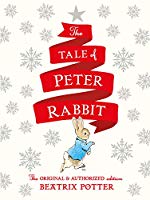
Review (The Tale of Peter Rabbit)

Bibliography: Potter, Beatrix. The Tale of Peter Rabbit. London, United Kingdom: Warne, 2019. ISBN-13: 9780141377490

Plot Summary: A mother rabbit and her four children live underneath the root of a tree. The mother rabbit tells her children that while she is out, they are allowed to play in the fields or down the lane, but mustn’t go into Mr. McGregor’s garden. It was in Mr. McGregor’s garden that their father rabbit had died and became a pie! Three of the rabbits listen to their mother, but Peter Rabbit decides to sneak into Mr. McGregor’s garden to eat some of his vegetables. Unfortunately, Mr. McGregor catches him and Peter has to figure out a way to escape!

Critical Analysis: While all of Peter’s problems arise from not listening to his mother in the beginning, this story is not necessarily a fable. The moral is set in a way where it is not outright stated, but can be used to teach children to interpret stories and the messages they convey. There is more concentration on the adventure itself, where Peter tries to escape Mr. McGregor’s clutches. Peter Rabbit runs and loses his clothes, he hides in a filled watering can, and he even has to sneak past a cat by the pond. The illustrations are beautiful, and one can tell how much Beatrix Potter loved the countryside with her loving details to the wild life, which she does all in watercolor. She even names out certain plants and foods associated with English gardens, such as fir trees, radishes, parsley, and blackberries. In a way, Peter Rabbit is in an adventure type of story that is not too different from a Tom and Jerry cartoon, but Peter is not entirely mischievous. There are sweet vulnerable moments where he cries about wanting to go home, making him not a static character, but someone you can have some sympathy with. While the ending is where he happily reunites with his mother, Potter touches wry humor here and there by having Peter going to bed earlier than his siblings due getting sick. Not to mention, the book has Mr. McGregor use Peter’s discarded clothes to make a scarecrow. This book can make children appreciate nature, but also understand consequences to actions the way Peter Rabbit has learned!

Review Excerpt and Awards won:

Has not won any recent awards, but was #19 on School Library Journal’s Top 100 Picture Books and was listed as a book “to grow on” by the American Library Association-Children’s Book Council Joint Committee in April 2003.

Following excerpt is from Publishers Weekly, dated April 22, 2002 by Julia Eccleshare:

“The enduring qualities of the entire The World of Peter Rabbit empire lie in Potter’s original stories and pictures, proving the all-embracing power of a good storyteller with a keen sense of her audience. Beatrix Potter understood this absolutely…Potter continued to write illustrated letters to other children and once wrote to the mother of one, “It is much more satisfactory to address a real child. I often think that was the secret success of Peter Rabbit: it was written to a child, not made to order.'”

Connections: Gather and read the other 22 tales by Beatrix Potter such as The Tale of Tom Kitten and The Tale of Squirrel Nutkin. Use this book as a lesson to children as to why parents or guardians tell them what not to do and the consequences if they do not listen. Also use this book to discuss gardening and how it works to children.

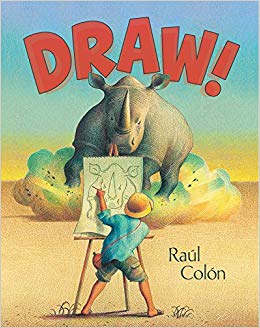
Review (Draw! by Raúl Colón)

Bibliography: Colón, Raúl. Draw! New York, New York: Simon & Schuster, 2014. ISBN-13: 9781442494923

Plot Summary: In artwork that goes from pale watercolors and hatching lines to richer, softer colored pencils, this book is about a young boy fantasizing about going on a safari after reading his books about Africa. He admires the animals and desires to draw them all. He bonds with an elephant and its cattle egret, who takes him to visit all the animals. The boy only has his easel, pencil, notepad, and lunch bag. He draws lions from a safe distance, shares lunch (and his hat) with the gorillas, and learns to placate a rhino on his adventure, and so much more. With this fantasy coming to an end, the boy in real life draws it out to share with his classmates.

Critical Analysis: There are no words in the picture book. No dialogue. We do not even learn the main character’s name. It is up to the reader to figure out who he is based on the rumpled bed sheets, the safari hat on his bed, the pencils and notepad near him. This kid is a dreamer and an artist. What the book does effectively is depicting which is real life and which is fantasy by changing the art style. As mentioned earlier, the story begins in watercolors, ultra-thin lines, with some hatched here and there to depict shadows and folds. As the story moves into fantasy, the lines are no longer so stark. The colors are warmer, deeper, and, seemingly, Colón switches to colored pencils which gives off a world that is softer, almost velvety-looking. The boy bonds with an elephant, the elephant’s cattle bird tags along, adding an amusing touch to the illustrations as it sits on the elephant’s head or back. When the boy finally ends his traveling, the cattle bird hides its face in its wing, as if crying while saying good bye. The book does well in showing the beauty and different facets of nature. This book will make any child desire to search outside themselves. This book encourages readers to invest in their own creativity.

Review Excerpt and Awards won:

Awards and honors: 2015 Charlotte Huck Award for Outstanding Fiction for Children (Recommended); 2015 Star of the North Picture Book Award (Nominee); and 2016 Georgia Children’s Book Award-Picture Storybook (Finalist.)

Following excerpt is from The Horn Book, dated September 8, 2014 by Kathleen T. Horning:

“The story line is engaging and easy to follow, and, while it’s whimsical, the majesty of the animals comes through in both the boy’s sketches and the main illustrations. Colón’s pen-and-ink, watercolor, colored-pencil, and lithograph pencil pictures are nicely textured and tinged with golden hues.”

Connections: This book can teach children about analyzing images to decipher the story. Use it for an activity where children are to draw out a story without relying on words and to see how others interpret their work. This work can also connect children to learning about African landscapes and what animals live there.

Edited: 2/16/2020

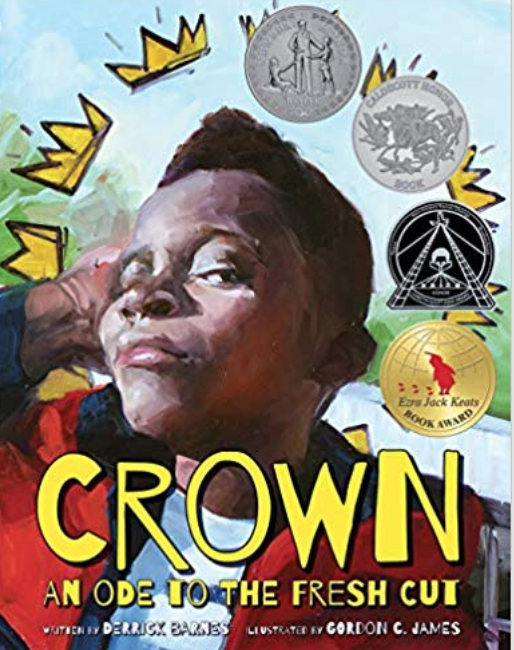
Review (Crown: An Ode to the Fresh Cut)

Bibliography: Barnes, Derrick, and Gordon C. James. Crown: An Ode to the Fresh Cut. Evanston, Illinois: Agate Bolden, 2017. ISBN-13: 9781572842243

Plot Summary: Lush oil paintings depict an unnamed African-American boy that is excited to go see the local barber. As he takes his seat, the boy imagines how people will react to his haircut and how he will feel about it himself. He also observes and admires the African-American people around him and thinks of the possibilities of how they live their lives. Ultimately, when he goes to the barber shop, he feels empowered by the end.

Critical Analysis: While we do not learn the name of our protagonist, the reader finds a young boy brimming with happy confidence. He is also the sort of person that appreciates the art and labor a barber goes into doing his and other people’s hair. Near the end. he even proclaims, “Tip that man! Tip that man! It was worth it. It always is.” The boy narrates in a stylistic way that, while it does not rhyme, it does have a lyrical quality that will make anyone enjoy using this title for a read-aloud. Children will especially get joy as you can emphasize certain words and lines. While the plot seems simple enough: a young boy enjoying his haircut, there is a deeper meaning to the story. There has been much controversy surrounding schools demanding black children to wear their hair in certain ways only. Just recently, a boy was not allowed to walk for his high school graduation unless he cut off his locs. To see a young boy be proud of his hair, and to see him admire the hair of other men and a woman, announces two things: hair can be important to identity and black hair is beautiful in all its forms. The artist depicts African-American people by giving their skin almost a dewiness, and all are smiling confidently. The artist also depicts the diversity of skin tones, body types, and ages between everyone. This is clearly a book of love and empowerment for a community.

Review Excerpt and Awards won:

Awards and Honors: 2018 John Newbery Medal (Derrick Barnes); 2018 Caldecott Honor Book (Gordon C. James); 2018 Coretta Scott King Book Award Honor (Derrick Barnes); and 2018 Coretta Scott King Book Award Honor (Gordon C. James).

Following excerpt is from Publishers Weekly, dated August 28, 2017:

“Pride, confidence, and joy radiate from the pages, both in the black and brown faces of men, women, boys, and girls featured in James’s majestic paintings, and in writing that celebrates human worth with every syllable. Barbers included…”

Connections: Use this book to run an activity that teaches children about mixing colors with oil pastels. Because this book features oil paints made in different colors such as pinks and oranges and blues to depict the varying skin tones of its characters, have the children make self-portraits where they can use any color they want, whether it is to show what color best represents them or if they want to use colors to show what they feel. This text can also be used to teach about self-esteem and to connect with other books about being proud of one’s unique appearance and personality and other traits, such as Stand Tall, Molly Lou Melon by Patty Lovell, The Name Jar by Yangsook Choi, and Amazing Grace by Mary Hoffman.

Edited: 2/16/2020